
 Millennium Centre:



Losing a front tooth can affect how you eat, speak and smile. A front tooth implant is one way to replace it, but the front of the mouth brings its own planning challenges.
At Carindale Family Dentist, we take a careful, step-by-step approach to tooth replacement and talk you through each option before any treatment begins.
Quick Overview
- A front tooth implant replaces a missing tooth root with a small post, topped with a crown that is shaped and shaded to suit your smile.
- It may suit people with a single missing tooth or one that needs removal, though bone, gums and general health all play a part.
- It can offer a fixed replacement option that does not rely on reshaping the neighbouring teeth, but planning in this area is more detailed than for back teeth.
- The thin bone at the front of the jaw, gum health and smoking can all influence how the result looks and lasts over time.
- An assessment with X-rays and 3D scans usually guides whether an implant, a bridge or a denture is the better fit.
Below, we explain how the dental implant procedure works for front teeth, what the research shows, and what affects the final result.
What Is a Front Tooth Implant?
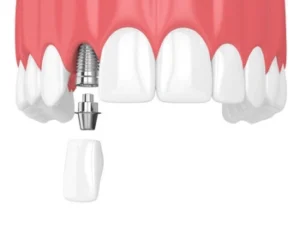
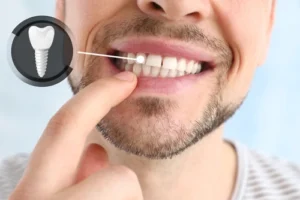 A front tooth implant is a small titanium post placed into the jawbone where the missing tooth root used to be. Once the bone has healed around it, a custom crown is attached on top. The result is a fixed tooth that you clean like your natural teeth.
The implant post acts as a stable foundation for the final restoration. A small connector, called an abutment, links the post to the crown. For a front tooth, the crown is matched to the shape, size and colour of the surrounding teeth so it blends in with your smile.
Implants can replace one missing tooth or multiple missing teeth. Read more about our dental implant treatment.
Why Are Front Teeth Harder to Replace?
Front teeth sit in what dentists call the “aesthetic zone”. Small details matter here, including the gum line, the shape of the crown and how light passes through the tooth.
Bone quality is a key concern. The bone covering the roots of upper front teeth is often very thin. A review of 29 scan-based studies found that around 70% of upper central incisors had less than 1 mm of bone on the outer side. When this thin bone is lost after an extraction, the area can shrink, and the gum may sink with it.
That is why a front tooth implant often needs more planning. Your dentist may look at:
- How much bone is left after the tooth is removed
- Whether bone grafting is needed to rebuild the area
- How the gum will heal around the new crown
- How your bite forces affect the front teeth
Our guide to bone grafts for tooth implants explains this additional treatment.
What Happens During the Dental Implant Procedure?
Every treatment plan is different, but most follow a similar path.
- Assessment and planning. Your dentist will review your medical history, check your gum health and take X-rays. A 3D scan is often used to measure bone height and width.
- Tooth removal, if needed. If the tooth cannot be saved, it is removed first. Sometimes the implant is placed at the same visit; other times the area heals first.
- Implant placement. The implant post is placed into the jawbone under local anaesthetic. This is a surgical procedure, so some swelling or tenderness is common in the days after.
- Healing period. The bone slowly bonds to the implant. This often takes around three months, though it can be shorter or longer.
- Final restoration. Once healed, the abutment and custom crown are fitted and adjusted to suit your bite.
During healing, a temporary crown or small partial denture can usually fill the gap. For more detail, read about the dental implant procedure or whether dental implants are painful, which covers pain management.
What Does the Research Say About Front Tooth Implants?
A large review of single crown implant studies found that 96.8% of implants were still in place after five years. The same review found that 8.7% of crowns had an appearance that was not acceptable, and around 9.7% of cases showed gum or tissue problems around the implant. These issues matter most at the front, where small changes are easy to see.
Smoking is one of the clearest risk factors. A review of more than 150,000 implants found that implants in people who smoke had about 2.4 times higher odds of failing than those in people who don’t smoke. People who smoke also tended to have more bone loss around the implant.
These numbers are averages. Individual outcomes vary, and your own risk depends on your health, habits and how the area is cared for.
What Affects the Result of a Front Tooth Implant?
Several health factors can shape how a front tooth implant heals and looks: 
- Bone quality and bone loss. Implants need enough bone to hold them steady. Thin or shrunken bone may need grafting first.
- Gum disease. Gum disease can lead to bone loss and may need treatment before implant placement. Our periodontics services focus on gum care.
- Smoking. Smoking can slow healing and is linked to a higher chance of implant problems.
- General health. Some conditions, such as diabetes, osteoporosis or bleeding disorders, may affect suitability. Some medicines can also affect bone healing.
- Gum thickness. Thin gums may let the implant show through, which can affect the look of the tooth.
Like any surgery, implant treatment carries potential risks. These can include infection, damage to surrounding teeth, nerve damage and sinus problems. Your dentist will explain the risks that apply to you.
What Are the Other Options for Replacing a Front Tooth?
An implant is not the only tooth replacement option. Your dentist may also discuss:
- A dental bridge. A bridge uses the teeth on either side of the gap to hold a replacement tooth. It does not need surgery, but the neighbouring teeth are usually reshaped to support it. Our comparison of tooth bridges and implants explains the trade-offs.
- A removable partial denture. This removable option can suit people who prefer to avoid surgery. Learn more about our dentures.
The right choice depends on your bone, gums, bite and preferences.
How to Care for a Front Tooth Implant
Implants can’t decay, but the gum and bone around them can still become inflamed. This is called peri-implantitis, and it can lead to implant failure if left untreated. Proper care helps protect your implant.
 Routine oral care for an implant is similar to caring for natural teeth. General advice on caring for implants suggests that you:
- Brush twice a day, paying attention to the gum line
- Clean between the implant and adjacent teeth daily with floss, interdental brushes or a water flosser
- Attend regular check-ups and professional cleans
Avoid biting hard objects like ice with your front teeth, and ask about a mouthguard if you play contact sports. Our dental implant aftercare guide has more tips.
A Considered Approach to Front Tooth Implants
Replacing a front tooth is a personal decision. A careful assessment helps you understand whether you’re a suitable candidate, whether you need extra steps such as bone grafting, and how an implant compares with other options.
If you’d like to explore whether a front tooth implant may be suitable for you, we welcome you to call Carindale Family Dentist on (07) 3324 9172.
Frequently Asked Questions
How long does a front tooth implant take?
The full process often takes three to six months. This includes healing after implant placement, and sometimes time for a bone graft to heal first.
Can you get a front tooth implant on the same day as an extraction?
In some cases, yes. This depends on the bone and gum, and whether the implant can be held firmly in place.
Are dental implants safe?
Dental implants are a well-established treatment, and research shows most single implants are still in place after five years. Like any surgery, there are risks, including infection and damage to nearby structures. Your dentist will review your general health and medical history to help manage these risks.
Will people be able to tell I have a front tooth implant?
The crown is made to match the colour and shape of your surrounding teeth. How natural it looks depends on factors like your bone, gum thickness and gum line. Your dentist can explain what to expect in your situation.
Is an implant or a bridge better for one missing tooth?
Neither is better for everyone. An implant does not rely on the adjacent teeth, while a bridge avoids surgery but usually involves reshaping the neighbouring teeth. The right choice depends on your bone, gums, bite and preferences.
Any surgical or invasive procedure carries risks. Before proceeding, you should seek a second opinion from an appropriately qualified health practitioner.
References
- Healthdirect Australia, Dental implant: https://www.healthdirect.gov.au/dental-implant
- Healthdirect Australia, Gum disease: https://www.healthdirect.gov.au/gum-disease
- Jung RE et al. (2008). A systematic review of the 5-year survival and complication rates of implant-supported single crowns. Clinical Oral Implants Research. https://www.ncbi.nlm.nih.gov/books/NBK75716/
- Facial alveolar bone thickness and modifying factors of anterior maxillary teeth: a systematic review and meta-analysis of cone-beam computed tomography studies (2021). BMC Oral Health. https://link.springer.com/article/10.1186/s12903-021-01495-2
- Mustapha AD, Salame Z, Chrcanovic BR (2022). Smoking and Dental Implants: A Systematic Review and Meta-Analysis. Medicina. https://www.mdpi.com/1648-9144/58/1/39